
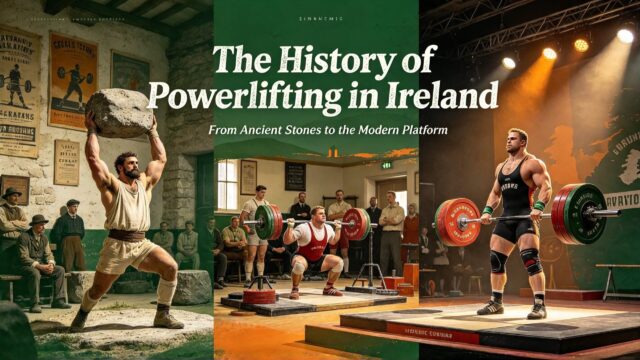
Introduction
If you’ve ever stepped onto a platform, chalked your hands, and squared up to a barbell that feels like it weighs the world — you’re part of a story that stretches back further than you might think. Powerlifting as we know it today might feel like a modern sport, but its roots run deep in humanity’s oldest impulse: to see just how much we can lift.
This is the story of how we went from lifting stones in fields to fully regulated competitions on a stage — and how that journey unfolded right here in Ireland.
Before It Had a Name: The Early Days
For thousands of years, strength was measured simply: could you lift it or not? Ancient civilizations had their tests of strength — the legendary lifting stones of Scotland, the Dinnie Stones in Aberdeenshire, and even tales from ancient Greece of men moving boulders to prove their might. But it was always individual feats, not a structured sport.
In the 19th century, travelling strongmen became the rockstars of their day. People like Louis Cyr — a Canadian giant who reportedly backlifted over 4,000 pounds — would tour theatres, performing feats that still seem impossible. There were no standard rules, no referees, and often a bit of showmanship mixed in. It was impressive, but it wasn’t powerlifting — yet.
Birth of a Sport: 1950s–1960s
It was in the United States during the 1950s that things began to take shape. Weightlifting was already an Olympic sport — but it was the “snatch” and “clean and jerk.” Many lifters felt there was something missing. What about the lifts that actually built the body? The squat, the bench press, the deadlift — these were the staples of every gym, but they weren’t being competed on a stage.
So they started organising their own meets. Early competitions were informal — sometimes held in the back of a gym, sometimes at a sports convention. Even the lifts themselves varied: some meets included curls or overhead presses. It was a bit of a free-for-all, but it was catching on fast.
By the 1960s, the “Big Three” — squat, bench press, deadlift — had emerged as the standard combination. The first true national championships were held in the USA in 1964. The sport had a heartbeat.
Going Global & Splitting Paths: 1970s–1980s
The 1970s was the era when powerlifting truly found its voice. The International Powerlifting Federation (IPF) was formed in 1972, bringing nations together under one set of rules. World Championships followed, and suddenly lifters from Britain, Australia, Canada, and beyond were competing on the same stage.
But the sport was also growing in different directions. Some wanted strict rules and Olympic-style governance. Others valued freedom of equipment, local autonomy, and the right to compete across different organisations without penalty. This natural diversity gave rise to multiple federations — each with their own flavour, philosophy, and community. That variety remains one of the sport’s greatest strengths today.
Some Fun Facts Along the Way:
– Bench press was actually the last of the “big three” to become a standard competitive lift — early meets often included the overhead press instead!
– For years, deadlift was contested with different rules — some places allowed hitching, some didn’t. It took a while for everyone to agree on what counted as a “good lift.”
– In the early days, there were no weight classes for women at all. It wasn’t until the late 1970s and early 1980s that women began to officially compete in their own right — a shift that completely transformed the sport.
– Lifters in the 1970s often trained in what looked like swimming trunks and t-shirts. Singlets and knee sleeves came much later!
Modern Era: Strength for Everyone
Fast forward to today, and powerlifting has exploded. It’s no longer a niche activity — gyms are packed with lifters of all ages, backgrounds, and body types. We have specialised gear, world records that keep climbing, and live-streamed competitions that reach thousands.
But the core hasn’t changed: it’s still about you, the bar, and what you can achieve. Whether you compete equipped or raw, in a local hall or an international stage — it’s still just strength, measured honestly.
The Irish Story: From Local Halls to World Stage
Here in Ireland, our strength heritage goes back centuries. The ancient Cloch an Aifrinn (Mass Rock) and various traditional lifting stones across every county show that testing one’s strength has always been in our blood.
In the 1970s and early 1980s, organised powerlifting began to take root. It started in community centres and gyms in Dublin, Cork, and Belfast. A small group of dedicated lifters would travel across the country — often on very basic roads — to compete in makeshift halls. There was very little money, almost no sponsorship, but huge heart.
Through the 1990s and 2000s, the sport matured. Standards rose, coaching improved, and Irish lifters began travelling internationally — and coming home with medals. We saw legends set national records that stood for decades, inspiring the next generation.
Today, Irish powerlifting is thriving. We have multiple active federations, competitions happening almost every weekend, and Irish lifters consistently placing at the very top of international competitions. Whether it’s the GPC’s open, inclusive approach or other federations pushing for Olympic recognition — we all share the same starting line: a love for lifting heavy things.
From the stone-lifters of ancient Ireland to the platforms of Tallaght, Limerick, and beyond — the story continues. And the best part? You’re part of it.
Got a memory or story from Irish powerlifting’s past that you’d love to share? Drop it in the comments or email media.gpcireland@gmail.com history belongs to all of us.
— The PowerliftingNews.ie Team