
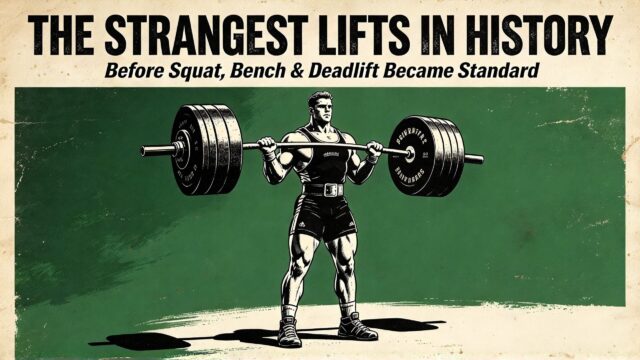
Today we know the big three: Squat. Bench. Deadlift. Simple, right? But go back 100 years and the lifting world was wild — absolutely wild. Lifters were hoisting heavy things in ways that would make a modern competition judge spit out their whistle. Some were incredibly difficult. Some looked completely bizarre. And all of them were once the height of strength sports.
Let’s take a trip back to when “standard lifts” hadn’t been invented yet — and when you could win a trophy for feats of strength that sound like myths.
📜 Once Upon a Time, There Was No “Big Three”
In the late 1800s and early 1900s, there was no governing body saying “you must squat this way” or “you must bench like this.” Competitions were more like: “Here’s a heavy thing. Figure out how to lift it.”
Strongmen and women would invent their own techniques, challenge each other to ridiculous feats, and — slowly but surely — some lifts stuck while others faded into legend. Here are the ones that made us go “wait, people actually did that?”
🏋️ THE BACKLIFT — The One That Broke Everything
What it was: Imagine a regular deadlift, but instead of holding the bar in front of you, it’s behind your legs. You stood on a platform, bent forward at the hips, reached back, and hooked your hands under a bar that ran behind your calves. Then you stood up straight. That’s it.
Why it was wild: Because the leverage was so different, people could lift absolutely massive weights — sometimes hundreds of pounds more than a regular deadlift. It became a legendary record-breaker in the early 1900s. The great Paul Anderson reportedly backlifted over 900kg — more than some people’s car!
Why it vanished: It put enormous strain on the lower back and hamstrings, and the technique was awkward. As the deadlift got standardised, the backlift slowly faded away — a victim of better biomechanics and safer rules.
“You haven’t truly fought gravity until you’ve tried to pick something up behind your own legs.” 😅
💪 THE BENT PRESS — Strength, Balance, and Magic Combined
What it was: This one looked less like lifting and more like a circus trick. You’d take a weight in one hand, bend your body sideways at the waist, and then — without using your legs to push — slowly press the weight overhead while staying bent over. Then lower it. All while keeping your feet planted.
Why it was wild: It required ridiculous flexibility, core strength, and coordination. You weren’t just strong — you had to be graceful too. Legendary lifters like Arthur Saxon could bent press more than most people could overhead press standing straight up. It was considered the ultimate test of a lifter’s complete control over their body.
Why it vanished: It was incredibly hard to judge — how much bend was allowed? Was that a little leg drive? It was also more of an art than a science. As competitions demanded clear, measurable numbers, the bent press became too subjective. Today it’s mostly found in strongman exhibitions and vintage strength circles.
🦾 THE ONE-ARM DUMBBELL LIFT — From the Ground to Overhead, Solo
What it was: No racks, no help. Just one heavy dumbbell on the floor beside you. Pick it up any way you like — swing it, jerk it, push it — but it had to end up locked out overhead, with your feet together and your body perfectly straight. That was the only rule.
Why it was wild: It was the ultimate test of one-sided strength. Your whole body had to stabilise itself against that massive weight hanging off one shoulder. It built functional strength unlike anything else — grip, core, coordination, everything working together.
Why it changed: Eventually, weightlifting developed the Snatch and Clean & Jerk — standardised two-handed movements that were more consistent across competitions. The one-arm lifts became niche — but many coaches still say they’re some of the best training exercises ever invented.
🪨 AND THE OTHERS THAT SOUND MADE-UP
It wasn’t just these three — there was a whole catalogue of wild lifts that once counted as serious competition standards:
- The Steinborn Lift: Pick up a heavy bar from the floor vertically, lean it onto your back, and squat it. Yes — really. 🤯
- The Side Press: Similar to the bent press but you leaned fully to one side. Wild core strength required.
- The Crucifix Hold: Hold weights out to your sides with straight arms — no lifting, just endurance. Some held this for minutes at a time.
- The Harness Lift: Wear a thick leather harness attached to a rope and pull a heavy cart or weighted sled forward using only your legs and hips. Still around in some strongman circles today.
⚡ How Did We End Up With Squat, Bench, Deadlift?
Simple answer: Consistency and fairness.
Different countries, different gyms, different lifters — everyone was doing their own version of everything. Judges were arguing over whether a lift counted. Records were meaningless because nobody was lifting the same way. So in the mid-20th century, organisations stepped in and said: “Okay. Three lifts. Here are the exact rules. Everyone does it the same way.”
And that was that. The big three gave us something beautiful — clarity. You could compete in Tokyo, Dublin, or Toronto — and everyone knew exactly what counted.
🔑 But Here’s the Beautiful Part
Those “strange” old lifts? They still have so much to teach us:
- ✅ The backlift showed us how incredibly strong the posterior chain can be
- ✅ The bent press taught body awareness that no machine can replicate
- ✅ The one-arm lifts revealed imbalances that symmetric lifting hides
- ✅ Every single one of them built real-world strength — not just gym numbers
Many modern coaches are bringing them back as accessory exercises — not for competition, but because they work. Maybe they weren’t weird — maybe they were just ahead of their time.
🎯 FINAL THOUGHT
Standards are wonderful — we need them. But don’t mistake “standard” for “only.” Before the big three, lifters were creative. They used what they had. They invented what they needed. Strength wasn’t about three specific movements — it was about the ability to move heavy things, period.
Maybe the weirdest thing of all isn’t the old lifts — it’s that we ever limited ourselves to only three in the first place. 💪
Ever tried any of these vintage lifts? Or have you seen someone do something wild in a gym that shouldn’t be possible? Tell us in the comments — we’d love to hear about it! 😊
— The PowerliftingNews.ie Team